
Ludwig Erhard Prize for Dr Robert Rühll
Award for innovative pension reform: Dr Robert Rühl, an economist from Bayreuth, has been awarded the Ludwig Erhard Prize for his doctoral thesis on the future of the statutory pension scheme. In this interview, the University of Bayreuth graduate explains the basic idea behind his ‘Resilience Pension’, discusses fairness in the pension system and explains why the debate on old-age provision needs a fresh spirit of reform right now.
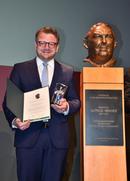
UBTaktuell: Dr Rühl, your doctoral thesis deals with reform options for the pension system. What led you personally to this topic?
Dr. Rühl: I have always been interested in politics. Whilst studying economics at the University of Bayreuth, I learnt to analyse political processes using the methods of political economy: How do reforms come about? Why do they fail? And which interests prevail? Pension policy links these questions to one of the most important social issues of our time. Originally, I mainly wanted to explain why necessary reforms so often fail. In the course of my work, however, another question came to the fore: what might a pension scheme look like that is both financially sustainable in the long term and fairer?
My supervisor, Prof. Dr Volker Ulrich, and I eventually agreed: whilst it is fascinating to investigate why reforms fail, it is even more important to develop concrete proposals for solutions.This is how the idea of the ‘Resilience Pension’ came about.
UBTaktuell: You advocate a degressive allocation of contribution points and an adjustment of pensions in line with inflation rather than wage growth. How, specifically, do these two measures contribute to greater fairness in pension entitlements?
Dr. Rühl: For me, the key question is what insured persons receive in return for their contributions over the course of their entire lives.
The adjustment of current pensions to inflation applies exclusively to current pensions. Pension entitlements and newly commencing pensions remain linked to wage growth. As wages rise more sharply than prices in the long term, current pensions will grow slightly more slowly in future. However, their purchasing power is maintained, whilst at the same time the pressure on funding is reduced. The older generation contributes through slower pension increases, whilst the younger generation continues to contribute through rising contributions. Furthermore, this creates an incentive to remain in work for longer. Those who retire later benefit for longer from more dynamic wage growth. This is a particularly relevant argument in the debate surrounding retirement at 63.
The second mechanism is the degressive allocation of pension points. Higher incomes continue to generate higher pension entitlements, but the entitlement no longer increases in direct proportion to income. The rationale behind this is that, statistically, people with higher incomes live longer and therefore, on average, receive a pension for a longer period. This degressive adjustment partially offsets this effect at the very outset of the entitlement. The ranking of pensions is maintained, but the expected return per contribution paid is adjusted. I see this as an important step towards greater fairness in benefits.

Thomas Scherer for Ludwig-Erhard-Initiative
UBTaktuell: Your research shows that population groups with higher pensions also live longer on average. How does this finding change the debate on fairness in the pension system?
Dr. Rühl: This finding challenges a widely held assumption. Statutory pension insurance is often understood as a system that redistributes wealth within a given age cohort from higher to lower incomes. However, when differences in life expectancy are taken into account, a more nuanced picture emerges. My research shows that the top income decile achieves a significantly higher internal rate of return from the pension system than the bottom decile. This results in an unintended redistribution in favour of people with higher incomes.
The debate on fairness should therefore not only consider the relationship between the young and the old, but also the differences within a single generation. This has implications for the assessment of reforms. For example, a uniform increase in the state pension age may appear neutral at first glance. In reality, however, it affects people with lower life expectancy more severely, as they will receive a pension for fewer years anyway. A defined-benefit pension system should take this relationship into account.
UBTaktuell: You completed your PhD at the University of Bayreuth. How did your time there shape you?
Dr. Rühl: I cannot imagine a better place to do a PhD. The combination of academic freedom, personal interaction and short lines of communication was particularly formative. At Prof. Dr Volker Ulrich’s department, I was able to develop my work over several years, challenge existing theories and rethink concepts. I was given a great deal of freedom in terms of content, but also received valuable input to sharpen my economic arguments.
Furthermore, I was impressed by the open and friendly culture at the University of Bayreuth. The campus encourages exchange across disciplinary boundaries, and the support from staff in the library, the Examinations Office and many other departments was exceptional. Without the University of Bayreuth and the people who shape it, this doctoral thesis would never have been written. I am very grateful for that.
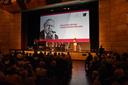
UBTaktuell: The Ludwig Erhard Prize recognises research that is particularly practical and socially relevant. Do you see a realistic chance that your reform proposals will be taken up by policymakers?
Dr. Rühl: When I submitted my doctoral thesis in August 2024, I would have been rather cautious in my assessment of those chances. Concepts that are scientifically sound do not automatically gain political acceptance.
Since then, however, the debate has changed noticeably. The work of the Pension Commission shows that fundamental reforms to the pension system are once again being seriously discussed. At the same time, in my view, key challenges remain: the burden on younger generations and the differences in life expectancy, which have so far been largely overlooked. This is precisely where the Resilience Pension comes in. Of course, academic reform proposals are rarely adopted in their entirety. However, individual core ideas are often incorporated into political concepts.
In particular, I believe that the separation of entry-level and existing pensions, as well as greater consideration of differences in life expectancy, are ideas that could be adopted. The chances of such approaches finding their way into the political debate are significantly greater today than they were just a few years ago. In my view, this is good news for the future of our pension system.

Dr. Stefan Fehm-Danoglidis
Press Spokesperson
eMail: stefan.fehm@uni-bayreuth.de
phone: +49(0)921 55-5300
mobile: +49(0)175 3553973