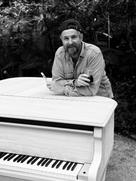
Amid the warm, humid greenery of the tropical house at the University of Bayreuth’s Ecological Botanical Garden, where leaves hang heavily in the air and the boundaries between continents blur, stands a light-colored object of almost disconcerting clarity: a concert grand piano from Steingraeber. Its wood is still unvarnished—a quiet, taut surface.
In front of it: Antoine Wagner (43), who is applying black ornaments to the instrument with a fine brush. Lines that stretch across the smooth surface like plant tendrils. Drones buzz overhead, cameras tracking every movement. The act of painting here is not just work, but a staging—a performance, a document, perhaps even a ritual.
Precision Meets Wildness
“It’s not every day you get a raw piano to paint,” says the man who is as fascinated by the world of music and sound as he is by the visual arts. And you can literally sense that the appeal for him lies above all in the break from perfection. A grand piano, built for precision, encounters an environment that appears wild—yet is equally curated: a tropical greenhouse, a “controlled forest.” Do they go together?
Wagner deliberately speaks of this tension. “This highly controlled object—I wanted to introduce a bit of chaos into it.” The choice of location follows this logic. Not just any studio, but a space that simulates nature while simultaneously staging it. “Where better than in a forest—a tropical forest—so that we can journey through various geographical locations, almost like in a mythology of trees.” With humidity around 70 percent and temperatures hovering around 30 degrees, the art project quickly turns into sweaty work.
For him, nature and music are not opposites, but share a common origin. “My work is always inspired by nature,” he says, “music and nature are at its core.” This gives rise not only to paintings, but also to installations, performances, and films—the project at the Tropenhaus is all of these at once.
The Constant Bayreuth
That this place is Bayreuth seems almost inevitable—and yet, at the same time, incidental. The artist lives in New York and grew up in France. And yet he has been returning here since his earliest childhood. “I’ve been coming here every year since I was a few weeks old,” he says. The city, inextricably linked to the name Richard Wagner, is for him less a stage than a constant in the background. After all, his mother, Eva Wagner-Pasquier— daughter of Wolfgang Wagner and his first wife, Ellen Drexel— served as co-director of the Bayreuth Festival alongside Katharina Wagner from 2008 to 2015. She has been a director at the Royal Opera House, Covent Garden, in London; artistic director at the Opéra Bastille in Paris; and artistic advisor to the Festival d’Aix-en-Provence and the European Music Academy.
For Antoine Wagner, however, the moment—the magic of the instant—is more important than tradition. The creative process of creation. The beginning of a line on light wood, the decision of where to place the first brushstroke. “There is no testing ground,” says Wagner. Everything depends on the angle of view, on how the object unfolds in space.
Four Wagner Grand Pianos in the Anniversary Year
Perhaps that is precisely what defines this project as part of the celebrations marking the 150th anniversary of the Bayreuth Festival: an instrument that normally produces sound becomes a surface in its own right. And while real nature continues to grow outside, another nature emerges here, inside the Tropical House—drawn, filmed, composed.
The grand piano in the jungle—an extraordinary project that certainly does not stand alone.
The Grand Piano in the Jungle – an extraordinary project that, of course, stands in a broader context. Antoine Wagner is also crafting three additional instruments at Steingraeber using woods from around the world – a continuation of his Impossible Forest project. Taken together, these elements form “a multifaceted ensemble of works that conceives of the piano not only as a sound-producing instrument, but as a place of ecological reflection and poetic reconstruction,” as stated in a press release from the Bayreuth piano manufacturer.
The unveiling of these four pianos will take place on July 22 at 11 a.m. at Haus Steingraeber in Bayreuth. The instruments will be accompanied by a video showing the process of crafting a grand piano in the Tropenhaus.