Logo Universität Bayreuth
Skip to contentSkip to footer
Logo Universität Bayreuth
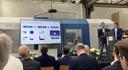
Vorstellung des neuen Demonstrators vor Industrievertretern

The Data4Collar research project, funded under the German Research Foundation’s (DFG) Priority Programme 2422, will enter its second funding phase in 2026. For a further three years, the University of Bayreuth and Fraunhofer IWU will jointly investigate how the process chain comprising shearing and collar drawing can be optimised using data-driven methods.

Collar drawing is an established sheet metal forming process used to manufacture functional formed features. Typical examples include collars that serve as fastening or connecting elements and can be found in a wide range of products, from automobiles to household appliances. Despite decades of practical experience, randomly occurring edge cracks continue to arise during the production of drawn collars. The causes of these defects are still insufficiently considered in current process design. The project therefore aims to ensure process robustness against fluctuations through the data-driven optimisation of tool working surfaces.

Gerissener Kragen an Bauteil

Cracked edge on a drawn collar.

During the first funding phase, a combined shearing and collar-drawing tool was developed for a circular collar geometry and equipped with extensive sensor technology to enable the collection of real production data during continuous operation. In addition, comprehensive simulations were carried out to gain a better understanding of the causes of edge cracking and to develop predictive models for process design. Machine learning methods were used to analyse the collected data. To provide users with a clearer understanding of the results, Explainable AI (XAI) techniques were also applied. These approaches offer insights into the decision-making processes of the models and make their predictions more transparent and understandable for users.

From Fundamental Research to Industrial Application

In the second funding phase, the models developed so far will be extended to more complex component and tool geometries, as well as to different materials and sheet thicknesses. This will further improve the transferability of the methods to industrial applications.

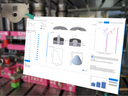
A particular focus will be placed on combining data-driven AI approaches with the practical expertise of specialists in metal forming technology. To mark the start of the second funding phase, a software demonstrator was presented at the Industrial Colloquium at the University of Stuttgart, where requirements and future fields of application were discussed with industry representatives. At the same time, new insights gained from practical applications will be continuously fed back into the models to further enhance their predictive capability, robustness and transparency.

In addition, a shared data infrastructure is being established together with partner projects within the DFG Priority Programme. This will help ensure the long-term usability of research data and promote common standards across the research community.

Foto der Oberfläche des Software-Demonstrators aus dem Data4Collar Projekt der Uni Bayreuth

Software demonstrator for the optimisation of process design in shearing and collar drawing operations.

With Data4Collar, the researchers are laying the foundations for an intelligent assistance system that will support the design of robust collar-drawing processes and significantly reduce the occurrence of edge cracks in the future.

Prof. Koschmider

Prof. Dr. Agnes Koschmider

Professorship for AI-based Product and Process Innovation
Webmaster: Team UBTaktuell