
The legacy of Prof. Dr. Dr. h.c. mult. Peter Häberle lives on
A two-day commemorative symposium was held at the University of Bayreuth at the end of September to honour the memory of Peter Häberle, a professor of constitutional law who passed away last year. Academics from across Germany gathered to pay tribute to the work of the long-standing Bayreuth constitutional law scholar and to discuss his significance in relation to current challenges in public law.
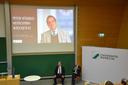
The programme for the colloquium was organised by Häberle’s younger academic pupils and ‘grandchildren’: Prof. Dr Markus Kotzur (Hamburg), Prof. Dr Julian Krüper (Bochum), Prof. Dr Lothar Michael (Düsseldorf) and Prof. Dr Johann Justus Vasel (Düsseldorf). On-site organisation was handled by the Chair of Public Law IV at the University of Bayreuth, of which Häberle was the first holder. Häberle, who spent the greater part of his academic career at the University of Bayreuth, shaped the reputation of its legal scholarship over many years, not least through the work of his numerous students. Under the current holder, Prof. Dr Carsten Bäcker, the chair continues to uphold Häberle’s academic tradition, in which constitutional law was always viewed from perspectives extending beyond legal doctrine.
The opening event on Tuesday evening alone made it clear just how highly Häberle is regarded far beyond Bayreuth. Following welcoming remarks and a discussion with international colleagues, Prof. Dr Dr h.c. mult. Dieter Grimm, a former judge at the Federal Constitutional Court, delivered the commemorative lecture. Grimm, who had witnessed Häberle’s work over the years and decades at the conferences of the Association of German Professors of Constitutional Law, traced his academic career through his contributions to these particularly traditional conferences. The lecture combined personal memories with scholarly analysis and was regarded by the participants as the most distinguished highlight of the event.

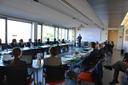

On the second day of the event, the focus was on key themes from Häberle’s work and their relevance today. In the morning, Dr Manuela Niehaus, Dr Sarah Dersarkissian and Assistant Professor Dr Philipp Overkamp examined various aspects of his thinking. Among other things, the discussion covered issues of climate protection from the perspective of Häberle’s ‘open society of constitutional interpreters’, the evolution of the constitution over time in the spirit of Häberle’s ‘Time and the Constitution’, and the significance of comparative law as, in Häberle’s words, the ‘fifth method of interpretation’ in the face of global challenges.
It became clear time and again just how international Häberle’s academic work was. His writings attracted attention worldwide, particularly in Latin America. From an early stage, he engaged intensively with other constitutional systems and viewed constitutional law not merely as a national endeavour, but as an international and comparative one. This openness towards other legal systems shaped the discussions at the colloquium. The afternoon concluded with a doctoral colloquium that drew on the tradition of the ‘academic intergenerational pact’ established by Häberle. Early-career researchers from various universities presented their doctoral thesis projects and discussed them in an open atmosphere with experienced legal scholars.
Overall, the commemorative colloquium made it clear that Peter Häberle was an exceptionally influential figure, not only within the Bayreuth legal community. His ideas on the open society, constitutional culture and comparative law continue to have an impact to this day and provide fresh points of reference for current debates. The event was therefore not merely a retrospective on an eminent scholar, but an encouraging look ahead to the future of his academic legacy.

Jennifer Opel
University of Bayreuth
Phone: +49 (0)921 - 55 5893 57
Mail: jennifer.opel@uni-bayreuth.de