
‘Science Against Fascism’: Commitment, Responsibility and Debates at the UBT
The nationwide initiative “Science Against Fascism” highlights the responsibility of universities to actively protect academic freedom. The University of Bayreuth also took part in early June 2026 with a week of action featuring a wide range of events designed to address the growing threats posed by far-right movements. This demonstrated just how important dialogue, education and engagement are for a democratic academic culture.
The nationwide initiative “Science Against Fascism” stands for a clear commitment: universities and research institutions are not only places for the production and dissemination of knowledge, but also for democratic responsibility. Academic freedom is a central fundamental principle of democracies. At the international level, it is defined, for example, by UNESCO, which emphasises that scientists have the right to choose their research freely, to acquire and disseminate knowledge, and to work without political or ideological pressure. In Germany, academic freedom is enshrined in the Basic Law: Article 5(3) of the Basic Law guarantees that “art and science, research and teaching are free”.
This freedom encompasses both the individual rights of researchers and the institutional autonomy of universities. At the same time, it is embedded in the constitutional order – and therefore goes hand in hand with responsibility, for instance towards ethical standards, the pursuit of truth and the fundamental rights of others. At a time when far-right positions are gaining social influence, it is becoming increasingly apparent just how much pressure science and teaching can come under. Attacks on and the discrediting of researchers and their findings, as well as attempts at political influence, show that academic freedom cannot be taken for granted, but must be actively practised and defended.
Against this backdrop, a nationwide week of action took place in early June 2026, focusing precisely on this responsibility. At the University of Bayreuth, too, students and staff took part with a varied programme of events that facilitated discussion, education and networking.
Action Week in Bayreuth: Exchange, Education and Advocacy
The Bayreuth Action Week, held from 1 to 7 June 2026, featured a variety of events that examined right-wing extremism and its consequences from academic, political and student perspectives. For example, the Department of Media Studies at the University of Bayreuth organised a special edition of its Games Night on Monday on the theme of ‘Anti-fascist games’. Until late into the night, visitors played video games that deal with fascism and forms of resistance in very different ways. These included serious games such as “Tribunal 45: Working on Justice”, “The Darkest Files” and “Svoboda 1945: Liberation”, which present historical contexts in an interactive way. In addition, web applications such as “Parable of the Polygons” and “Fake it to make it” offered insights into mechanisms of exclusion and the spread of fake news.
The board game “Space Cats Fight Fascism” and the indie game “EXTREME MEATPUNKS FOREVER” offered a lighter-hearted take on the theme, allowing players to experiment with resistance in a playful way. Among the most frequently played titles were the satire “Hitler’s Cactus – or only you can stop Trump”, games from the “Wolfenstein” series, and “Phonopolis”, which explores the theme of escaping a totalitarian system. The selection showcased different approaches to the theme, which varied greatly in their execution. Alongside media studies students, a number of external guests also took part. The event offered the opportunity to engage with the theme in an informal setting and strike up conversations.
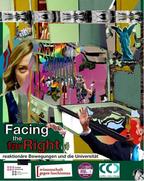
On Tuesday, “Studis gegen Rechts” organised an interdisciplinary lecture evening on fascism and the shift to the right. A talk on the death sentence handed down to Leo Hartmann by the Bayreuth Special Court in 1943 was followed by a presentation on “Conspiracy Theories & Fascism”. Finally, a student spoke about his asylum case and his deportation, which was fortunately prevented. Between the talks, there was time for questions and discussion. On Wednesday at midday, the event “Facing the Far Right: Reactionary Movements and the University” took place, focusing specifically on the university context. The Mobile Advisory Service against Right-wing Extremism in Bavaria (https://www.lks-bayern.de/beratung-bildung/mobile-beratung) works with local authorities, educational institutions, initiatives and individuals who find themselves confronted with right-wing extremism, racism or anti-Semitism.
The aim is to identify concrete courses of action, impart knowledge and develop long-term strategies to strengthen democratic structures. In organisational terms, the Mobile Advisory Service against Right-wing Extremism in Bavaria is part of a nationwide network. Funding is generally provided by public funds, in particular through programmes at federal and state level aimed at promoting democracy. The work is independent, confidential and needs-based.
The Department of Digital and Audiovisual Media had organised a film evening on the theme of ‘anti-fascism’: from a silent film that powerfully illustrated how the festival took place during the Second World War as part of Nazi propaganda, to music videos such as “Sommermärchen” by Apsilon about the NSU murder in Dortmund in 2006, “K4L” by Ebow and “Alexa Alexa Antifascista” by KAFVKA & Antifuchs, a wide range of perspectives were explored. A key driving force behind the action week in Bayreuth was the commitment of staff and students. The student initiative “Studis gegen Rechts” organises regular events, provides information on far-right structures and advocates for an open, supportive university culture.
The week of action in Bayreuth has shown that the “Science Against Fascism” initiative is more than just a symbolic statement. It reflects a growing awareness that academic freedom must be defended. Where democracy comes under pressure, the freedom of research and teaching is also at risk. At the same time, the academic community offers vital resources for countering far-right narratives with facts. The events have impressively demonstrated the importance of networking, information and engagement. They have created spaces in which knowledge could be shared and courses of action discussed – precisely what defines a vibrant and responsible academic community and an open society.

Dr. Elena Köstner
Equal Opportunities Department
University of Bayreuth
Phone: +49 (0) 921 / 55-2192
E-mail: elena.koestner@uni-bayreuth.de
www.frauenbeauftragte.uni-bayreuth.de/en

Jennifer Opel
University of Bayreuth
Phone: +49 (0)921 - 55 5893 57
Mail: jennifer.opel@uni-bayreuth.de