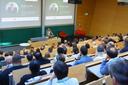
In his keynote speech, ‘The Meat Proxy and the Role of AI Explanations’, Prof. Dr Niklas Kühl explored the question of how people can evaluate the results produced by AI systems. The focus was on Explainable AI (XAI), i.e. the comprehensible explanation of decisions and results. Kühl made it clear that explanations alone are not enough: expertise is needed to assess whether a system’s reasoning is actually sound.
The practical application of AI was the focus of the keynote speeches by Lisa Precht, Head of AI at IBM DACH, and Martin Braun from Neuro Forge GmbH. Precht highlighted the challenges involved in introducing AI into organisations, such as those posed by established data structures or siloed solutions. However, she argued that the real task is to ensure long-term control over AI systems. Braun used practical examples to demonstrate that not every conceivable application is worthwhile. The decisive factors, he said, are the concrete benefits and the ability to verify results in a transparent manner.
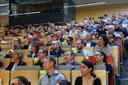
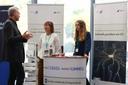
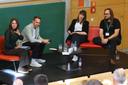
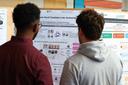
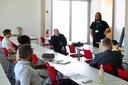
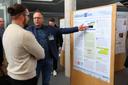
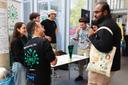
In addition to the presentations, AI Day offered numerous opportunities for discussion. Workshops and a panel discussion provided a forum for exploring different perspectives on the use and societal significance of AI. Interest was high: with 270 registrations, the event was fully booked. Researchers and companies also presented current projects and applications relating to artificial intelligence in the foyer of the RW building.
The exhibition highlighted just how firmly the topic is now established in research, knowledge transfer and practice. For Niklas Kühl, the exchange of ideas beyond the confines of the university was a particular success. “Both academia and industry could benefit equally from sharing AI expertise,” he said. AI Day 2026 thus demonstrated that the development of artificial intelligence can only succeed through collaboration between research, business, politics and society.