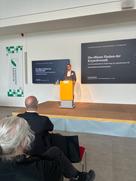
At the opening, Prof. Dr Nina Nestler, Vice-President for Internationalisation at the University of Bayreuth, emphasised the importance of exchange between research and practice. She noted that the dialogue taking place at the conference was also an expression of the university’s ‘Third Mission’. The aim, she explained, was to transfer excellent basic research into the economy and society and to provide sustainable impetus for future collaborations.
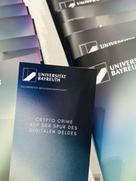
The conference focused on the question of how investigative authorities can solve crimes committed using cryptocurrencies. This is because digital currencies have long been used not only for legal transactions, but also play an important role in fraud, money laundering and other forms of cybercrime. The particular challenge lies in analysing money movements on the blockchain and identifying perpetrators despite the extensive pseudonymity of those involved.
Dr Bernhard Haslhofer from the blockchain analysis firm Iknaio provided an insight into modern methods of crypto-forensics. He outlined the latest developments in transaction tracing and the possibilities offered by data-driven analytical methods.
Prosecutors Lisa Dauphin and Anna Diana Saam from the Bavarian Central Cybercrime Unit explained how such tools are used in practice. Drawing on their experience from criminal investigations, they demonstrated the importance that the analysis of cryptocurrencies has come to play in the fight against cybercrime.
Further presentations focused on regulatory and criminal law issues. They examined current money laundering compliance requirements and their significance for financial service providers and crypto service providers, as well as the criminal law challenges posed by so-called ‘crypto theft’, and discussed new forms of crime on decentralised finance platforms.
The discussions during the 3rd Bayreuth IT Criminal Law Conference highlighted just how dynamically digital financial systems are evolving and how closely technology, the law and law enforcement are now intertwined. Around 70 participants attended the event. “The high number of participants shows that, once again this year, our choice of topics has appealed to representatives from academia as well as from the legal and policing professions,” summarised Prof. Dr Christian Rückert, holder of the Chair of Criminal Law, Criminal Procedure and IT Criminal Law at the University of Bayreuth.