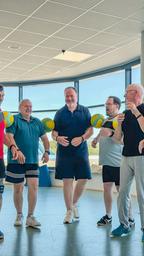
The Chair of Social and Health Sciences in Sport at the University of Bayreuth, headed by Prof. Dr Susanne Tittlbach, is responsible for the project ‘Männersache im Heilbad’, which is funded by the State Office for Food Safety and Health. Research assistant Tizian Schuck is involved in the design and implementation of the programme and, amongst other things, led the practical sports sessions.
The intensive week was aimed at men aged 45 and over who wish to improve their physical activity levels and health behaviours. The main venue was the Siebenquell GesundZeitResort in Bad Weißenstadt am See. The project also made use of the spa town’s unique health and natural resources, including the spa forest, the spa gardens and other locations within the town.
The programme combines daily exercise sessions with health-promoting activities offered by a health resort. As well as strength, endurance and coordination exercises, the programme also included playful forms of movement, outdoor activities and group sports sessions.
The programme was complemented by forest bathing, forest yoga, aqua cycling, health walks and an introduction to Kneipp therapies. Leisure activities such as a guided tour of the town and a mine walk were also part of the week. “For the first time in years, I’ve really worked up a sweat through exercise. The exercises and the playful activities really pushed me to my limits – I haven’t done this much sport in years,” said one of the participants.
“For the first time in years, I’ve really worked up a sweat through exercise. The exercises and the games really pushed me to my limits – I haven’t done this much sport in years,” says one of the participants. The University of Bayreuth is not only investigating how the programme is run, but above all its impact.
The focus is on questions regarding the acceptance and feasibility of the concept: How do participants experience the exercise and health activities? Which elements are perceived as particularly motivating? And can an intensive health week trigger long-term changes in everyday life?
Before, during and after the intensive week, various health-related factors are assessed, including subjective health, well-being, quality of life and psychosocial health resources. Upon their return, participants receive a further eight weeks of digital support. This research design makes it possible to observe changes beyond the actual intervention week.
Initial feedback has been positive. Particular praise was given to the combination of exercise, health promotion and the sense of community, as well as the high level of enjoyment offered by the sports sessions. “It does ache a bit, but it’s a pleasant feeling. I didn’t overdo it and the intensity was just right,” says another participant. Despite the demanding programme, the participants largely perceived the intensity as appropriate and well-balanced.
Another run of the programme is already planned: the second intensive week will take place from 20 to 26 September 2026. Using the insights gained there, the University of Bayreuth aims to further develop the concept and collect additional scientific data on health promotion for men.