
18th Mathematics Day
The 18th Mathematics Day 2026 at the University Bayreuth - Math Sharpens Your Perspective
The 18th Mathematics Day took place with great enthusiasm on Saturday July 11, 2026, at the University of Bayreuth. Approximately 310 students from 27 schools in 20 towns came to showcase their mathematical skills in an exciting group competition and to experience mathematics through interesting lectures and interactive labs.
While the students worked on their assignments, Martin Braun from NeuroForge discussed current challenges and opportunities related to artificial intelligence in schools and the classroom with the teachers. The open exchange between the teachers and the practitioner (a former computer science student at UBT) was inspiring for both sides. “AI as a colleague and assistant” can enrich instruction and make work easier, Braun emphasized. However, there was also consensus on the need to teach and learn how to critically evaluate AI-generated answers. After the lunch break, Dr. Lisa Krügel from TenneT introduced the students to the world of power grids. In her engaging and interactive presentation, she used numerous examples to illustrate that clear definitions are crucial for identifying and systematically analyzing disruptions in the grid. Mathematics is an essential part of the process that delivers electricity from the wind farm in the north to our homes continuously and in line with demand.
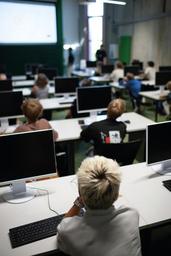
Under the slogan “Mathematics from Data,” Prof. Dr. Péter Koltai from the Institute of Mathematics covered a wide range of topics, from computer-based image analysis to predicting droughts and stock prices. He demonstrated how the “discovery of simplicity” helps process unimaginably large datasets and thus make them usable. A real “aha moment” for many participants was the central role of chance, which—often unintentionally—simplifies not only life but also mathematical analysis.
In the labs, the young people were able to step into the roles of researchers and engineers themselves: In the Space Simulation Lab, they guided a rocket from Earth to Mars, skillfully selecting gravity, speed, timing, and other physical parameters. As in the previous year, the program progressed from simple models to realistic challenges. The “Mathematical Brain Teasers” drew participants in with the joy of mental stimulation. These labs consistently offer new challenges presented in an engaging way: one example is Leonardo da Vinci’s revolutionary design for a wooden bridge without nails. And the new tile-laying game “Tetrix” by StD Erik Sinne generated a lot of excitement: a captivating strategy game that demands both quick thinking and creativity. In addition to the scientific highlights, there were also opportunities to relax.
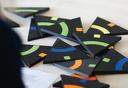
Mathematical puzzles
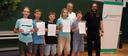
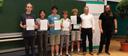
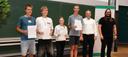
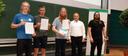
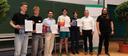
The awards ceremony in the Audimax brought the successful day to a close. Following welcoming remarks by Prof. Dr. Vadym Aizinger (Organization), Prof. Dr. Volker Ulm (Vice President for Teaching and Students), and Michael Hagel (Siemens AG), Prof. Dr. Alfred Wassermann (Competition Director) and Prof. Dr. Melanie Birke (Organization) presented the awards to the top teams in the mathematics competition. Prizes went to teams—or, in the case of mixed teams, to individual students—from Markgräfin-Wilhelmine-Gymnasium in Bayreuth (5 times), Dientzenhofer Gymnasium in Bamberg (2 times), Graf-Münster-Gymnasium in Bayreuth (1 time), Frankenwald-Gymnasium in Kronach (1 time), Gymnasium Fränkische Schweiz in Ebermannstadt (1 time), Caspar-Vischer-Gymnasium in Kulmbach (1 time), Gymnasium Parsberg (1 time), and Schiller-Gymnasium in Hof (special prize for the most creative solution).
We would also like to thank all the tireless volunteers: the faculty members and secretaries, the researchers, and the students at the Institute of Mathematics at the University of Bayreuth.