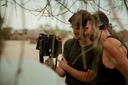
Das Filmgespräch bietet nicht nur einen exklusiven Blick hinter die Kulissen, sondern auch die Gelegenheit, mit den Filmschaffenden über die Entstehung des Projekts, die Dreharbeiten in Turkana und die gesellschaftliche Dimension des Films ins Gespräch zu kommen. Für die Universität Bayreuth ist es zugleich ein besonderes Heimspiel – denn die Wurzeln dieses internationalen Erfolgs liegen auch hier.
From the seminar room to Hollywood
Director Kevin Schmutzler, a graduate in media studies from the University of Bayreuth, looks back on his time as a student in Upper Franconia with great gratitude. Although the NAWI project only came about years later, it was based on student film projects and intensive support from the department, he explained in an interview with the university press office.
Schmutzler was already involved in international projects during his studies, including a graduation film in India. ‘In Bayreuth, we had the freedom to think big,’ he recalls. ‘If the concept was sound, the department and the university were behind us.’ Practical relevance, close supervision and a strong network were decisive factors. In fact, several alumni of Bayreuth's media studies programme worked on NAWI – many of them still collaborate closely on creative projects today.
For Schmutzler, the fact that the film is now being shown in Bayreuth is more than just another date on the festival list: as students, they presented their work at the Media Night on improvised screens – now he is returning with his first major cinema film. ‘Above all, joy,’ he says of his return. ‘It's something very special to show the film at home.
A story that became bigger than planned
NAWI tells the story of a 13-year-old girl from Turkana in northern Kenya who rebels against an arranged child marriage and fights for education and self-determination. Important to know: the film is based on true events! What began as a film workshop developed over the years into an international cinema project. In 2017, Kevin (35) and his brother Toby (33, who will be attending the film discussion in Bayreuth) travelled to the region for the first time. The original plan was to offer creative workshops in collaboration with a local organisation. A story competition initially gave rise to the idea for a short film – but during a screenplay workshop, the story unexpectedly grew into a feature-length film. ‘Suddenly we no longer had a 20-page script, but a 100-page one,’ recalls Kevin Schmutzler. It was crucial that the project remained locally rooted: the story was written by a Kenyan author and filmed entirely on location with local actors. The international team saw themselves as partners – not as outside narrators.
Filming took place in 2023, followed by post-production in 2024. In 2025, an impressive festival tour began with over 50 stops worldwide. The film received around 25 international awards, including prizes at renowned festivals such as the Raindance Film Festival, the Beijing International Film Festival and the LA Pan African Film Festival. It was also submitted as Kenya's official entry for the Oscars (!). For Schmutzler, the success is moving – not as a sudden triumph, but as an organic development: ‘Looking back, it's amazing where this project came from – and where it is now.’
A leading actress with her own story
Lead actress Michelle Lemuya plays a special role. During school tours in Turkana, the team specifically sought out children who not only acted out the reality of the film, but also understood it. Michelle was eleven years old when she raised her hand at the casting – assuming it was for a school play. During the interview, she said that two of her best friends had been married the year before. It was clear to the team that here was a girl who not only had talent, but also an inner connection to the story. Today, Michelle is a young ambassador for girls' education in East Africa. She received an African film award for her role, which led to international inquiries. Her first trip outside Kenya took her straight to the awards ceremony – and shortly afterwards to Los Angeles for the Oscar campaign. In Bayreuth, she will not only talk about the film, but also about her life. ‘You won't get rehearsed answers from her,’ says Schmutzler. ‘Instead, you'll get honest, direct perspectives.’
Film and responsibility
NAWI is more than just a film. The accompanying NAWI initiative supports educational projects and campaigns for vulnerable girls in Turkana. From the outset, it was important to the team to work sustainably – local crew members were paid and involved, and local structures were strengthened. Future projects are also emerging from this collaboration. New films dealing with migration and integration are in the pipeline, including stories from the Kakuma refugee camp in Kenya and a Bavarian story about integration through sport.
A film that should be shared
The team does not have the large marketing budgets available to blockbusters. The film's success depends on personal exchange – on people going to the cinema and telling others about it. The premiere in Bayreuth offers the ideal setting for this: film screening, audience discussion and meeting the creative team.
Film screening and discussion
- When? Friday, 6 March 2026, starting at 6:15 p.m.
- Where? Cineplex Franz & Gloria in Bayreuth
- What? First the film will be shown (99 minutes), followed by a discussion
-
Participants: Co-director Toby Schmutzler, producer
Lydia Wrensch and lead actress Michelle Lemuya