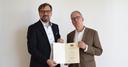
A native of Austria, Christoph Kurat studied molecular biology and biochemistry at the University of Graz. He earned his doctorate in biochemistry in 2008 at the same university, where he subsequently worked in teaching and as a research associate. He completed his postdoctoral training at the University of Toronto in Canada, where, supported by an EMBO Long-Term Fellowship, he researched histone transcription and the cell cycle for four years. In 2013, he moved to the laboratory of Dr. John Diffley at the Francis Crick Institute in London, England, with a Marie Curie Fellowship. There he focused on replication research and the in vitro reconstruction of replication processes. From 2017 onward, he was a group leader at the Biomedical Center (BMC) of Ludwig Maximilian University of Munich, and in 2025 he was admitted to the prestigious Heisenberg Program of the German Research Foundation (DFG). As part of this program, he has now taken up the Heisenberg Professorship for Genetics II at the University of Bayreuth.
“The move to the University of Bayreuth was a no-brainer for me,” says Kurat. “In Munich I was based on a medical campus, but I always wanted to return to the pure natural sciences. I feel that I fit in very well in Bayreuth. In addition, there is already top-level research here on transcription, translation, and the cell cycle—but not yet on replication. That’s where I come in.”
During his research at LMU, he and his team discovered that a replication origin in baker’s yeast—a model organism in genetic research—has an additional essential function in replication. Kurat plans to continue this research in Bayreuth and transfer it to a human system. “Professor Stemmann’s chair in Bayreuth already has such a system for human expression up and running. In the future, I want to find out whether the findings from my study also apply to higher eukaryotic systems. I also aim to investigate how mutations in protein complexes that bind at the replication origin may contribute to cancer,” Kurat explains.
The opportunities for interdisciplinary collaboration also convinced Kurat to come to Bayreuth. “My goal is to establish as many interdisciplinary collaborations as possible within the university and beyond. I am convinced that through close cooperation we can strengthen our research sustainably and achieve exciting progress,” says Kurat.