
German Team Wins Soil Judging World Championship
At the Soil Judging World Championship in Nanjing, China, a student team including members from the University of Bayreuth demonstrated outstanding expertise in soil science and brought the world title home to Germany. The team was coached, among others, by Bayreuth agroecologist and soil scientist Andreas Wild.
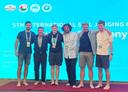
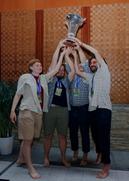
The winning Soil Judging team (from left to right): Andreas Wild, Simon Marx, Jule Schwormstede, Alexander Tevzadze, Sebastian Kolbinger and Tobias Klöffel
Over recent decades, soil science has become increasingly differentiated into numerous specialised sub-disciplines. As a result, the classical, strongly field-oriented approach to soil science—pedology—has become less visible. Yet pedology centres on one of the discipline’s most fundamental skills: understanding soil as a three-dimensional natural body in the field, interpreting its genesis, describing its horizons, placing it within a broader landscape context, and ultimately deriving its functions for both people and nature. This integrative knowledge is essential for numerous related disciplines, for the interpretation of measurements and field experiments, and ultimately for a comprehensive understanding of ecosystems.
To preserve and promote this classical field-based approach to soil science while facilitating generational renewal within the discipline, the international soil science community has established so-called Soil Judging competitions. The largest of these competitions is held every four years in conjunction with the World Congress of Soil Science, where teams from around the globe compete against one another. For this reason, the event is widely regarded as the Soil Judging World Championship.
This year’s championship took place in Nanjing, China. The 72 participating students from 15 countries first underwent intensive training through workshops and field exercises. Excursions took participants into a variety of landscapes around Nanjing, characterised by fertile fluvial and aeolian deposits. Particularly impressive were the region’s intensively managed paddy rice soils. These soils have developed through centuries of wet-rice cultivation and are characterised by heavily compacted plough pans, prolonged flooding of fields, and the associated redox processes.
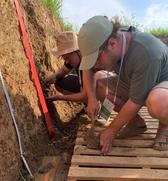
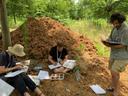
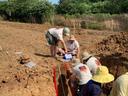
Soil aggregates reveal a great deal about the properties of a soil. The assessment begins with a meticulous description of soil characteristics, including soil horizons, texture (sand, silt and clay content), structure, colour, carbonate content, and much more. The individual pieces of information are then assembled like a puzzle to classify the soil and evaluate its functions.
In the subsequent competition, the German team—with student participation from the University of Bayreuth—prevailed against strong international competition and won the Soil Judging World Championship team title. Teams of four students, comprising bachelor’s, master’s and/or PhD candidates, were required to fully describe soil profiles in the field within a limited timeframe, classify them according to international standards, and interpret their site-specific functions.
The German team consisted of: Sebastian Kolbinger (University of Bayreuth, Geoecology), Alexander Tevzadze (formerly Technical University of Munich; future doctoral researcher at the University of Bayreuth), Jule Schwormstede (University of Hohenheim), Simon Marx (Technical University of Munich). The team was coached by Andreas Wild (University of Bayreuth, Agroecology) and Tobias Klöffel (University of Copenhagen).
The championship trophy will remain with the German Soil Science Society (Deutsche Bodenkundliche Gesellschaft) in Göttingen until the next World Congress of Soil Science, which will take place in Toronto in 2030.
For the participants—and for the University of Bayreuth—the success in Nanjing demonstrates the enduring importance of combining modern scientific education with practical field experience in order to achieve a deeper understanding of soils.
The German team celebrates its world championship title, proudly holding aloft the winner’s trophy. Russia, the United States, Poland and Korea followed in the subsequent places. Special thanks go to the German Soil Science Society for its support.
Andreas Wild
University of Bayreuth
Phone: +49 (0)921 / 55-2177
E-Mail: andreas.wild@uni-bayreuth.de