

Wild Campus: How the University of Bayreuth supports biodiversity
The University of Bayreuth actively promotes biodiversity through its sustainability strategy and has already created 33 biodiversity areas on campus. Through insect-friendly maintenance, new sandariums for endangered species, and the species-rich Ecological Botanical Garden, valuable habitats for plants and animals are being created.
Anyone who, when thinking of biodiversity at a university, first thinks of the variety of degree programs and their students is certainly not alone. However, the more than 11,000 plant, insect and animal species on campus far outnumber us. The campus is thus no longer just a place for learning and working, but also an actively shaped habitat for biodiversity.
The fact that this is no coincidence but a strategic choice is evident in the 2021 sustainability strategy, through which the University of Bayreuth has committed to “establishing a system for monitoring biological diversity and further promoting it, in particular by optimizing the proportion of near-natural and restored areas across the entire campus.” What may sound abstract at first is now evident in many concrete examples: 33 designated biodiversity areas covering a total of over 52,000 square meters now shape the campus landscape. The first of these were designated as early as 2016, and their number has grown steadily ever since.

Key to the success of these areas is how they are maintained. In collaboration with the Ecological-Botanical Garden (ÖBG), the Central Technical Department has developed what is known as an “insect-friendly mowing regimen”: About 20 percent of the areas are mowed in the summer to allow for a second bloom, while the remaining 80 percent are mowed in the fall to keep the soil nutrient-poor and thus more species-rich. Since 2023, the university has also participated in the nationwide “Mowing-Free May” initiative: all green spaces remain unmowed during this time so that early-blooming plants can set seed and insects can find sufficient food during a particularly important phase of the year.
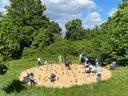
The story of two new sand gardens on campus illustrates just how creative biodiversity conservation can be. After the “Summer Feeling” event at Unistrand in 2024, approximately 700 metric tons of sand were available. Instead of being disposed of, the sand was taken over by the ÖBG and stored temporarily. In the spring of 2025, in collaboration with the student initiatives Scientists for Future and the university chapter of the Landesbund für Vogelschutz, two new sandy areas were created: one in front of the Geo II building and one at the ÖBG itself. More than 20 volunteers planted over 150 drought-tolerant wild plants there. For ground-nesting wild bees, digger wasps, and sand ground beetles, such open, sandy areas are a rare refuge, as they have long since become scarce in the intensively farmed landscape surrounding them. As “ecological stepping stones,” the campus sandstone formations also serve as a link to other natural areas in what is known as “Bayreuth’s Green South.”
The Ecological-Botanical Garden itself plays a special role in this ecosystem. More than 9,000 plant species from all over the world grow on its 16 hectares, while more than 2,000 native species have established themselves there naturally. The small-scale mosaic of dunes, dry grasslands, forests, bodies of water, and bogs makes the Ecological-Botanical Garden one of the most species-rich sites in Central Europe. A total of 230 wild bee species and 170 bug species have already been recorded here. The garden is also an important educational venue—over 300 guided tours and projects reach more than 10,000 visitors annually, and since 2021, the educational program has held the “Umweltbildung.Bayern” seal of quality. For students and staff, the ÖBG also offers a practical, free retreat in the midst of everyday university life.
Targeted efforts are also being made to protect specific species groups. In cooperation with the State Association for Bird Protection and students, a monitoring program for bird strikes on buildings took place from April through December 2024. The high-risk areas on building facades identified during this program are now being gradually mitigated, and bird protection will be incorporated from the outset in future new construction projects.
All these measures—from mowing to the sandariums to the ÖBG—follow the same basic principle: creating structures that are as diverse as possible so that as many species as possible can find a habitat suited to their needs. For the University of Bayreuth, this is a central component of its sustainable campus development: Biodiversity is not treated here as a side issue, but as part of what makes a campus fit for the future—vibrant, diverse, and open to all, whether human, animal, or plant.

Jennifer Opel
University of Bayreuth
Phone: +49 (0)921 - 55 5893 57
Mail: jennifer.opel@uni-bayreuth.de