
Alumna of the University of Bayreuth wins art competition
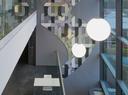
"Art on the Building" ("Art on Building"): The winning design "perspective in surface" by artist Jasmin Schmidt is now on display in the foyer of the PNS building.
The artist Jasmin Schmidt was born in Regensburg in 1981. From 2002 to 2005 she studied "Culture and Society of Africa" (B.A.) at the University of Bayreuth, before she moved to the Academy of Fine Arts in Nuremberg (class of Prof. Thomas Hartmann, master student) to study free painting.
After spending time abroad, teaching and winning various prizes, in the spring of 2021 Jasmin Schmidt won the "Kunst am Bau" (Art on Buildings) competition, organized by the Bayreuth State Building Authority, for the Polymer Nanostructures (PNS) building on the campus of the University of Bayreuth. The State Building Authority pursues two goals with the art competition: To promote young artists and to make art accessible to a broad public. The focus is always on contemporary art, which should inspire and invite discourse.
Since this week, the winning design by Jasmin Schmidt is on permanent display in the foyer of the PNS building.
The young artist was available for an interview with the UBTaktuell editorial team.
What was your personal journey to art?
Jasmin Schmidt: Via detours: I have always been interested in art, but only studied painting when I was 27. Before that, I looked at contemporary visual art from the African continent and fortunately, during a study visit with an artist in South Africa, I was motivated to switch from the role of viewer to producer and start studying at an art academy.
How would you describe your artistic practice?
I consider myself a painter; my work builds on the discourses of image formation through colour on image carriers of the last centuries. In doing so, I understand pictures as "new places". These pictorial places arise in the picture and can only be visible in it. I do not describe them, I do not show them, but I help them to emerge.
What inspires you in your work in general?
On the one hand, I like to work with objects I discover, which give my painting an impulse but are often no longer recognisable in the finished painting. These can be small objects, colours, but also terms or sounds. On the other hand, I start from the painting medium itself - the foundation of the painting - which has varying material qualities and thus develops specific characteristics to which I can react. The combination of these two aspects and an equally explorative and patient observation leads to a continuous process of inspiration until a work is completed.
Annette Kradisch
Now your work perspective in surface is being installed on the UBT campus - in the building for "Polymer Nanostructures" (PNS): What is the story behind that? What came first: the artwork - or the building that inspired you with its research focus?
I developed my work perspective in surface specifically for the building and its research focus. For this, I dealt with plastic as an image medium, and ventured into new territory for me. The challenge was to find a way to create an image with this material that corresponds to my artistic practice.
Formally, the design is oriented towards clear forms and geometries, which play a role in many of my paintings. Dealing with the material as an image medium meant that I could address the issue of paint beading on plastic and thus pursue my fundamental interest in bringing image medium, image object, and painting into correspondence.
Why did the jury choose your design?
The jury praised the curved form's interlacing, which is oriented towards the macro-structures of plastics, as a content-related reference to the research focus, and particularly emphasised the harmonious overall effect of this work, which responds to the spatial structure of the foyer as well as the colour concept of the architecture.
What does the artwork do to the foyer of the PNS building?
During its conception, it was important to me that perspective surface work with the dynamics of the building. The open character of the foyer, which extends over three floors, should not be obstructed, but rather expanded. The wall design cannot be viewed in its entirety from any position in the building. Perspective in surface continuously emphasises the existing architecture and its own form through refractions, gaps, reflections, repetitions, and transparencies. With each movement of the viewer through the building, the wall design invites a constant change of perspective.
How does a viewer access your artwork on campus - and what is the idea of your work associated with that?
My
wall design establishes connections between chemistry and art. The basic idea
is that both artistic and chemical research are characterised by finding,
observing, and then changing structures. Through the reorganisation of
structures aimed at by the respective research, a modelling of surface always
takes place at the same time. In this way, surfaces in art and in chemistry can
be understood as complex, explorable realities that express underlying
meanings. Perspective in surface illustrates that chemistry and art have
in common the creation of perspectives on the basis of surfaces. Here,
perspective is to be understood both as the optical point of view of an
observation and as a future-oriented, content-related moment.
Credits: Annette Kradisch
Does a university represent a special environment for art - and thus also for your artwork? Does the UBT, where you also studied, hold special significance for you?
A university is indeed a special place for art, because there the negotiation of knowledge and research are both consensus and task. This space for free and concentrated contemplation is valuable and is comparable to the situation in the studio. For me personally, showing perspective in surface at the University of Bayreuth closes a circle.
I was inspired to think and develop my own perspectives at the University of Bayreuth, I was able to develop this further visually during my art studies in Nuremberg, and now a continuation of this path has led me back to the University of Bayreuth in the form of a painting. I am therefore especially happy to have had this opportunity.

Tanja HeinleinLeitung Marketing Communications
Universität Bayreuth
Abteilung Presse, Marketing und Kommunikation
Zentrale Universitätsverwaltung – ZUV
Zimmer Nr. 3.07
Universitätsstraße 30
95447 Bayreuth
Tel.: +49 921 / 55-5317
E-Mail: tanja.heinlein@uni-bayreuth.de