
“We need to promote science”
How can science communication be made effective? In her new course at the University of Bayreuth, science communicator Dr Wiebke Finkler combines strategic science communication with marketing, psychology and practical filmmaking. The aim is to equip students to tell relevant stories, reach people and make science visible and effective. Not just in Antarctica, but in Bayreuth too.
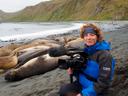
Wiebke Finkler filming in Antarctica. Sea elephants can be seen in the background.
From Upper Franconia to New Zealand – and back again: for Dr Wiebke Finkler, things have come full circle at the University of Bayreuth. “I’ve been moving between two worlds for a long time – but now, for the first time, the opportunity has arisen to teach a course at the University of Bayreuth,” she says. During a sabbatical in 2024, she got to know Professor Martin Obst (Experimental Biogeochemistry), amongst others. Initial discussions quickly led to more: namely, the idea of strategically expanding science communication on campus – and offering a dedicated course on the subject for the first time. The first – theoretical – part of the course has already taken place, and participants will soon begin working on specific film projects.
From the lab to the camera – and into the world of stories
Finkler’s path into science communication was anything but straightforward. She studied biology in Greifswald, later specialising in marine biology and working with killer whales off the North American coast. But even back then, she sensed that something else fascinated her more: “The research itself was interesting – but I became increasingly interested in the topic of communication within the scientific community.”
A documentary film course proved to be a turning point. “That opened up a whole new world for me,” says the Bremen native. Not just conducting science, but telling its story visually – creatively, artistically, emotionally – that captivated her. Her path eventually led her to New Zealand, to the University of Otago. “Almost 30 years later, I’m still here.”
“Raising awareness is no longer enough”
What fascinates Finkler about science communication is the shift in perspective: away from simply imparting knowledge, towards making a real impact. “Raising awareness is no longer enough,” she emphasises. “If nothing changes afterwards.” She advocates a more strategic approach that also draws on methods from marketing and psychology. “We need to understand who we want to reach – and how.” The aim is communication that can change behaviour: “Behavioural change is possible – but for that we need better tools.”
For her, the key lies in strategy, emotions and storytelling. “Why should people be interested in science if it isn’t relevant to their own lives?” Communication must move people, not just inform them. The basis for this is consistently target-group-oriented communication, as well as sound research that focuses on people’s needs, values and perspectives. And: “We must make people the heroes of the story – not the scientists.” Citizen science is a good example of this: people are actively involved and experience a sense of self-efficacy.
From whales to science – and back again
Finkler’s experiences in marine biology continue to shape her to this day. Encounters with ‘charismatic megafauna’ – whales, dolphins, penguins – have shown her just how powerful emotions can be. ‘These animals have an incredible effect on people.’ This power can – and must – be harnessed to make scientific content accessible. At the same time, she warns against focusing solely on “cute” topics: “We mustn’t forget the less visible or less ‘cute’ topics – but it’s often easier to get people interested through dolphins or penguins than through an unsightly beetle.”
The course: Science, marketing – and filmmaking
Finkler is now incorporating all these approaches into her new course at the University of Bayreuth. It is based on three pillars: traditional science communication, strategic communication and marketing – as well as practical filmmaking. Her choice of words is deliberately provocative: “We really do need to sell our science. We can no longer assume that people automatically recognise the value of science.” She therefore places particular emphasis on mobile filmmaking. “The best camera is the one we have in our pocket.” Students learn to produce videos using simple means and their own mobile phones – from the initial idea through the storyboard to the finished film. Her most important goal: self-efficacy. “My main goal is for people to say at the end: ‘I can do it.’” Technical perfection is secondary. “A bit of camera shake is fine now and then – that’s authentic too.” Especially on social media, the story counts for more than a glossy production.
Learning through real-world projects
A key feature of the course is working with real-world clients – for example, in the field of sustainability or in collaboration with Bayreuth Municipal Utilities. Field trips and practical placements are an integral part of the programme. “Students work on real projects – from the initial idea right through to the finished product.”
The results will be presented to the public on 2 July. “A premiere where anyone who wishes to can see everything that has been created as part of our project.”
“We need stories of hope”
Finkler is also concerned with the question of how to communicate about major societal challenges such as climate change. Many people feel overwhelmed or paralysed, particularly when it comes to complex issues. Science communication and behavioural science can help counteract this – provided they convey a sense of hope. “We need stories of hope,” says the globetrotter. Stories that show that change is possible, that people can make a difference. “It’s about giving people the tools – for positive change.”
Artificial intelligence also plays a role in the course. “You can’t ignore it anymore.” AI is a tool – but one that carries risks, for example through fake news. “It’s becoming increasingly difficult to tell what’s real and what isn’t.” This makes it all the more important to teach the relevant skills.
A model for the future?
It remains to be seen whether the course will be offered again after the launch. Interest is high: “We’re almost fully booked,” says Finkler. “If it goes well, I’d be happy to come back next year.” But one thing is already clear to her: science communication will become even more important in the future – and it needs to be bolder. “We need to step out of our comfort zone,” she urges. It requires “more emotion, more strategy. And more impact.”
About the person
Dr. Wiebke Finkler is a science communicator, marketing researcher and senior lecturer at the University of Otago in New Zealand.
After completing her degree and PhD in New Zealand, she specialised in communicating scientific content to a wide audience, particularly in the context of environmental and behavioural issues. Born in Bremen and raised in Hesse and with her grandparents in Upper Franconia, her career path led her to New Zealand, where she now combines research, teaching and practice-oriented projects in science communication and behaviour change marketing. A key focus of her work is on innovative formats such as visual storytelling and mobile filmmaking, as well as on the question of how communication can drive social change. She has received international recognition for, among other things, her film project “Mount Kinabalu”, which was awarded the Special Jury Award at the 11th International Kuala Lumpur Eco Film Festival in 2018. Wiebke is also the author of the award-winning book *The Science of Hope: Eye to Eye with our World’s Wildlife*, which was published internationally by Exisle Publishing in 2021.
The Ross Sea lies between Marie Byrd Land and Victoria Land in the Southern Ocean in Antarctica.
Gert-Dieter Meier
Tel. +49 921 55 5356
E-Mail: gert-dieter.meier@uni-bayreuth.de