
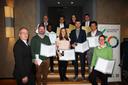
Celebrating Outstanding Commitment
This year’s President’s Dinner once again saw numerous awards presented for exceptional teaching, remarkable research achievements, and impressive social engagement.
On Friday, 5 December 2025, the restaurant Liebesbier in the heart of Bayreuth was once again transformed into a stage for special moments: the University of Bayreuth honoured individuals who have distinguished themselves through outstanding teaching, notable research contributions, and extraordinary social commitment.
Following the welcome address by University President Prof. Dr. Dr. h.c. Stefan Leible, a total of seven awards were ceremoniously presented. The evening concluded with a dinner speech by former State Secretary Dr Josef Lange, entitled “50 Years of UBT – What (Still) Isn’t in the History Books”. The event was expertly hosted by Angela Danner, Head of the University’s Press, Marketing and Communications Service Unit.
Golden Raven – University Award for Outstanding Teaching
This year, the Bayreuth Teaching Award “Golden Raven” was presented to two recipients: Christina Schwarz and Johannes Häring.
Christina Schwarz received the award for her tutorial on Higher Mathematics 2, in which she conveys complex content with such clarity and vividness that even the most challenging topics become accessible. Through clear, sometimes playful exercises, she creates a learning environment where genuine understanding can flourish. She also employs innovative teaching methods such as digital polls via QR code. Her tutorials are often even more popular than the preceding lectures.
Her exceptional teaching quality is no coincidence: Christina Schwarz earned the Bavarian University Teaching Certificate – Advanced Level after completing 204 hours of training at the University of Bayreuth’s Centre for University Teaching (ZHL).
Johannes Häring was honoured with the “Golden Raven” for his Mechatronics tutorial, aimed at bachelor’s students in the Faculty of Engineering. In his sessions, Johannes Häring fosters an atmosphere where questions are not only allowed but actively encouraged. Students are treated as equals and motivated to participate. He also integrates innovative teaching methods that link theory and practice: for example, he introduced the use of VR headsets to deepen learning and supervises a laboratory course where theoretical knowledge is applied in practice.
Johannes Häring’s commitment extends beyond the lecture hall. As long-standing chair of the Bayreuth regional group of Technik ohne Grenzen (“Technology Without Borders”) – an organisation providing technical assistance for self-help in developing countries – he coordinates projects and keeps the group together.
Bayreuth University Award for Digitally Supported Teaching
This award recognises lecturers who show exceptional dedication to designing teaching and learning processes using digital resources. This year, Prof. Dr. Lena Kästner received the prize for her course AI, Robots, Superintelligence: Philosophy in Fiction. In this weekly seminar, ten students debated the nature of intelligence and artificial intelligence, comparing philosophical concepts with scenarios from science fiction. The aim was to critically analyse philosophical arguments and reflect on the impact of AI on society and the future.
Professor Kästner met the challenges of the seminar with numerous interactive elements and the integration of student initiatives, creating a creative, interdisciplinary, and innovative learning environment at the University of Bayreuth.
DAAD Prize
This year’s DAAD Prize went to Mercy Onyango, who impressed with her broad academic interests at the intersection of linguistics and literary studies, as well as her social commitment to vulnerable and socially disadvantaged groups.
Since 2024, Onyango has been studying for a master’s degree in African Verbal and Visual Arts with a focus on African Linguistics in Bayreuth. Her research explores the impact of artificial intelligence and social media on language, society, and artistic expression.
As a teaching assistant, Onyango shares her expertise, actively supports fellow students, and fosters a positive and productive learning environment. She not only helps others with private revision sessions but also advocates for vulnerable groups – particularly people with disabilities – and fights against their stigmatisation in society. Currently, Onyango is involved in the Rotaract Club Bayreuth, where young people organise social projects. She is also passionate about sustainability and environmental protection, having participated in reforestation projects in Kenya to help combat climate change.
International Club Award
The International Club Award honours outstanding young researchers at the University of Bayreuth for international social engagement and academic excellence. This year, Dr Heyou Zhang received the award. Since 2022, he has been a postdoctoral researcher at the Chair of Soft Matter Spectroscopy under Prof. Dr. Jürgen Köhler, working in a highly advanced and competitive research field.
During his PhD at the University of Melbourne, Australia, he developed a new technique for designing metamaterials, nanolasers, and sensor platforms. He further advanced this technique in Bayreuth, achieving the world’s first realisation of a purely optical logic gate through a multidisciplinary approach and collaboration with chemists.
Despite his early career stage, Dr Zhang already boasts an impressive publication record and has attracted significant attention for his research at international conferences. Beyond his research, Dr Zhang is a dedicated tutor and mentor for international doctoral candidates, supporting the next generation of scientists at the chair.
City of Bayreuth Award
Once again this year, Lord Mayor Thomas Ebersberger presented the City of Bayreuth Award for outstanding doctoral theses. The award went to Dr. Fabian Eller, Dr. Anna Krombacher, and Dr.-Ing. Nico Leupold.
Dr. Fabian Eller received the award for his PhD thesis in Physics entitled “Enabling Tailored Nanostructure Control in Organic Semiconductors with Accelerated Nanostructural Analysis”. The reviewers described his results as “methodologically impressive, systematic, and expertly interpreted”. Particularly noteworthy is his successful control of molecular arrangement at the nanoscale in his experiments – a factor of utmost importance for efficient organic solar cells.
His work was supervised by Prof. Dr. Eva M. Herzig, Chair of Experimental Physics, Dynamics and Structure Formation.
Dr. Anna Krombacher was honoured for her dissertation on the use of digital technologies to address societal and ecological challenges. Her thesis is entitled “Digital Social Innovation: Leveraging Digital Technologies for a Sustainable Future”.
In her research, Dr Krombacher combines the fields of “Digital Innovation” and “Social Innovation” into a new area: “Digital Social Innovation”. She has broken new ground at the University of Bayreuth, being the first doctoral candidate at the Research Institute for Information Management to explore this topic in depth. Her work was supervised by Prof. Dr Maximilian Röglinger, Chair of Information Systems and Business Process Management.
Dr.-Ing. Nico Leupold was recognised for his dissertation, which makes an important contribution to the global energy transition. His thesis is entitled “Aerosol-Based Cold Deposition of Halide Perovskites: From Powder to Solar Cell”. In his research, Leupold developed novel synthesis methods for halide perovskites and, for the first time, produced solar cells using powder aerosol deposition.
His work was supervised by Prof. Dr.-Ing. Ralf Moos, Chair of Functional Materials.
Science Award of the University Association Bayreuth e.V.
The Science Award of the University Association Bayreuth e.V. is presented annually for outstanding academic achievements to promote early-career researchers at the University of Bayreuth. This year, the award went to Dr Franz Krah.
Dr. Krah is a mycologist working in a research area that is still far less explored compared to flora and fauna. His work combines ecological, evolutionary, and data science approaches to understand the dynamics and adaptability of fungal communities in the context of global environmental change.
Even in his early research, he demonstrated a deep understanding of ecological relationships. His master’s thesis on the evolution of wood-decaying fungi led to the publication of a widely cited study (Krah et al. 2018, BMC Evolutionary Biology). His PhD resulted in a paper in the prestigious Journal of Ecology. Particularly noteworthy is his subsequent work on the thermoregulatory function of fungal pigmentation (Nature Communications), which helped establish a new research field – the so-called “colour biology” of fungi. Today, with an h-index of 15 (Google Scholar) and 30 scientific publications, several in leading journals, Dr Krah is a highly productive early-career researcher.
Award for the Advancement of Women
In 2025, the University of Bayreuth presented the Award for the Advancement of Women in the category “Proportion of Female Professors at W2/W3 Level” to the Faculty of Engineering. The prize money of €10,000 in this category is available for the faculty to use at its discretion.
More information on the awards and the winners: https://www.universitaere-preise.uni-bayreuth.de/de/index.html

Angela Danner
University of Bayreuth
Office: Room No. 3.07, Central University Administration (ZUV),
Universitätsstraße 30, 95447 Bayreuth
Phone: +49 (0) 921 / 55-5323
E-mail: angela.danner@uni-bayreuth.de