
Forest restructuring in times of climate change
Research project at the Ecological Botanical Garden: 'Potential of alternative tree species in climate change - early detection of drought stress on experimental plots in Bavaria'.
Against the background of climate change and the visible consequences for the forest after the hot, dry summers of 2018 and 2019, forestry is looking for a replacement for its bread-and-butter tree species spruce and pine. In this context, the main focus is on drought-stress tolerant indigenous tree species, which have so far been of little or no importance in forestry. In addition, it must also be considered whether and to what extent non-native tree species will be needed in the future to maintain important forest functions ("assisted migration").
For this reason, the Bavarian State Institute of Forestry and Forest Management initiated the KLIP18 project in 2012. This is a long-term cultivation trial at locations in Bavaria, Thuringia, Austria, and Switzerland along a climate gradient. The aim of this experiment, with participation by the Ecological Botanical Garden (ÖBG) of the University of Bayreuth, is to test the suitability of alternative tree species for cultivation under current and future climatic conditions in comparison with an autochthonous tree species.
The most important criterion for the selection of the species was that they originate from a native area where the climate is already as we expect it to be. Furthermore, the trees had to be species that are expected to be of value to forestry, and for which there has been no previous experience of cultivation in Central Europe. Specifically, the following species are being studied: Oriental beech (Fagus orientalis), silver lime (Tilia tomentosa), Lebanon cedar (Cedrus libani), and western hemlock (Tsuga heterophylla), as well as the native reference tree species, the pedunculate oak (Quercus robur).
After the successful establishment of all tree species at the sites (Frischbier et al. 2019, Maier 2019), their drought tolerance is now being investigated in a pilot study using ecophysiological methods. Since May 2020, Dr. Viviana Horna Rodriguez de Zimmermann and Dr. Markus Schmidt at the ÖBG have been conducting the project 'Potential of alternative tree species in climate change - early detection of drought stress on trial plots in Bavaria'. This project is funded by the Bavarian State Ministry of Food, Agriculture and Forestry and will initially be limited to one year.
Photosynthesis, leaf transpiration, and the water potential of the plants are being measured in several campaigns during the growing season on the experimental plots in Großostheim near Aschaffenburg and in Schmellenhof near Bayreuth. In the laboratory of Prof. Bettina Engelbrecht (Functional and Tropical Plant Ecology of the University of Bayreuth) the water potential at the leaf wilting point is additionally being determined. The change in stem radius is measured continuously to determine the daily and seasonal dynamics of growth as a function of weather, soil water content, and water potential of the plant. Furthermore, the embolism susceptibility of the water conducting tissue (xylem) is a species-specific property that characterizes the hydraulic-physical limits of water transport in the xylem. This is being determined in cooperation with Prof. Bernhard Schuldt, University of Würzburg. The project is supported by BayCEER data processing, namely Dr. Stefan Holzheu and Oliver Archner. For example, hardware and software from the BayEOS environmental data acquisition system will be used to measure soil water content and temperature.
Finally, the expected results covering different aspects of the drought resistance of trees will be compared in a matrix to describe the strategies used by the respective tree species. This should begin pointing the way for future forestry practice, and if and which non-native tree species will be suitable for the urgently needed forest restructuring.
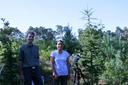
(Photo: Viviana Horna and Markus Schmidt measure photosynthesis and transpiration on a Lebanon ceder on the trial plot in Großostheim in August 2020.)