
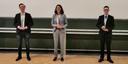
Vishay Technology Prize awarded to outstanding students of the Bayreuth Faculty of Engineering Science
The award has been in existence for 12 years, and this year again three students from the University of Bayreuth have been honoured. They share prize money amounting to € 4,000. The prizes were presented by Martina Winterwerber, Managing Director of Vishay Electronic GmbH. She congratulated Rebekka Stephan (centre) as main prize-winner, Lukas Maar (right) in second place, and Johannes Welsch (right) for his special prize.
Over the last twelve years, the Vishay Technology Award 2020 has been awarded to students of the Faculty of Engineering Science at the University of Bayreuth with outstanding achievements in the first semesters of their studies. Since this part of the programme requires students to navigate personal development from student to student, while at the same time teaching the basics that are particularly important for the future engineering profession, this part of the programme is considered to be the most difficult.
Potential award winners must be among the best students in their year and are expected to achieve consistent, outstanding academic performance within an appropriate time frame, particular emphasis being placed on excellence in subjects especially important to Vishay.

Having done well here is a particularly good basis not only for further studies, but also for your future career.
The Vishay Technology Prize
The lack of engineers in Germany is affecting Upper Franconia particularly severely. Vishay Electronic GmbH and the Faculty of Engineering at the University of Bayreuth are striving to counteract this shortage and provide clear opportunities to upcoming engineers. With its Vishay Technology Award, the company, a global manufacturer of electronic components listed on the U.S. stock exchange, whose CEO is based in Selb/Ofr. at Vishay European Central, underscores how important the engineering profession really is, and how important good engineers are for the renowned Upper Frankonian industrial region. This is why Vishay has sponsored its technology prize, which is awarded annually. The prize winners are always students of the Bayreuth engineering courses. Vishay is expressly interested in maintaining contacts with its neighbouring university, and thus in promoting the availability of well-trained engineers.
The jury consists of representatives of Vishay, of the University of Bayreuth’s Faculty of Engineering Science professors, and of Fischerauer and Moos, who are particularly involved in the business fields of Vishay Electronic GmbH’s "discrete semiconductor components" and "passive electronic components".

Prof. Dr.-Ing. Ralf MoosChair of Functional Materials
University of Bayreuth
Nürnberger Straße 38 / Haus 1
D-95448 Bayreuth
Tel: +49 (0) 921 / 55-4672
Mail: ralf.moos@uni-bayreuth.de