
Encouraging fun in scientific work
Maths, computer science, natural sciences and technology (STEM): While young children's interest in these subjects often seems endless, enthusiasm often fades as they get older. STEM educational experiences are designed to keep the enthusiasm alive. Prof. Eva M. Herzig supports such a project at Bayreuth's Luitpold School.
Often it is just a small spark that can ignite a fire of enthusiasm. And although Prof. Dr Eva M. Herzig did not show the pupils of the Luitpold School in Bayreuth experiments with fire, but with water and ice, many such fires were lit. "It is important to me to support children in pursuing their questions and being allowed to live out their curiosity," says Prof. Dr Eva M. Herzig, Professor of Experimental Physics - Dynamics and Structure Formation at the University of Bayreuth. "I want to encourage the fun of scientific work and of course I also hope that the enthusiasm you see at an event like this will last."
The cooperation with the Luitpold Primary School began two years ago. "When my child started school, I organised a visit to the university for experimentation in consultation with the teacher," Herzig says. "This then developed into a good collaboration, which we have continued this school year in the project 'It works?!'"
It works?! is a project of the Bildungswerk der Bayerischen Wirtschaft (bbw) e. V. educational initiative "Technology - Future in Bavaria". bayme vbm, the Bavarian metal and electrical employers' association, is the main sponsor of the project.
At the beginning, there was the art theme "Kingfishers", which gave rise to the core question of under what circumstances water turns to ice. Based on this initial problem, other exciting questions developed and the research project "Mysterious Water" was born. From January to May 2023, 25 children aged 7 to 8 explored, among other things: How do icicles form? Why is ice so slippery? How does ice/snow fall from the sky? Is there plastic in snow? What do snowflakes look like?
Prof. Herzig acted as a learning companion for the award-winning project. "The students then came to our campus with their questions and did a lot of experimental research and testing," Herzig says. Herzig organised the day at the university with her team and especially with the support of Thomas Dabisch. Herzig also paid a visit to the school, where the evaluation of the experiments and the experience gained was then made in the group. "There was also really good feedback from the school," says Herzig. "The teacher Michaela Heinrich told us that this project of targeted free work allowed the children to show what they were made of, regardless of their previous academic performance." The school will use the prize money to purchase materials for further experiments that can be integrated into lessons.
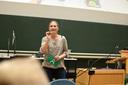
Prof. Dr. Eva M. HerzigDynamics and Structure Formating - Herzig Group
Telefon: +49-(0)921/55-2619; +49-(0)1522 212 4242
E-Mail: eva.herzig@uni-bayreuth.de

Stefanie Raab-Somabe, Organiser of Girls' Day & Coordinator of STEM programmes | Equality QM Officer
Equal Opportunities Staff Unit at the University of Bayreuth
Universitätsstraße 30
Building B8
D- 95447 Bayreuth
Phone: +49 (0)921 / 55-2218
Mail: chancengleichheit@uni-bayreuth.de